
Executive Summary
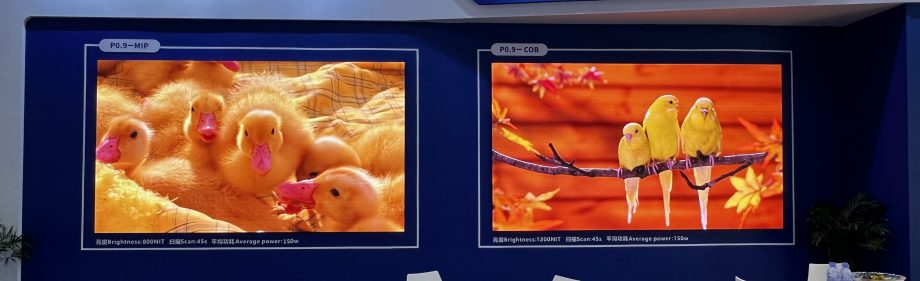
The LED display industry is undergoing a seismic shift. In Q1 2025, SMD (Surface-Mounted Device) technology’s market share fell to 77.6% (down 2% YoY), while COB (Chip-on-Board) surged to 22.1% and MiP (Multi-in-Package) reached 0.3%. This report explores the drivers behind this trend among SMD vs. COB vs. MiP, compares the technologies, and forecasts their future roles.
1. Market Share Analysis: Why SMD Is Losing Ground
1.1 The Decline of SMD
SMD has dominated LED displays for decades due to its mature supply chain and cost efficiency. However, its limitations in micro-pitch displays (below P1.2) are becoming apparent:
Pixel density limits: SMD’s single-pixel packaging struggles with pitches below P1.0.
Higher maintenance costs: Annual upkeep averages 2.3× more than COB.
Production bottlenecks: Achieving finer pitches requires expensive upgrades.
1.2 The Rise of COB and MiP
| Metric | SMD | COB | MiP |
|---|---|---|---|
| 2025 Q1 Share | 77.6% | 22.1% | 0.3% |
| YoY Change | -2% | +2.2% | +0.1% |
| Best Pitch | ≥P1.2 | ≤P1.0 | ≤P0.9 |
COB’s growth drivers:
Simplified production: Integrates chips directly onto PCBs, reducing steps.
Price drops: Average COB product prices fell 31.4% YoY in 2025.
Durability: No exposed wires, reducing failure rates.
MiP’s niche advantages:
Flip-chip design: Enables higher resolution and better thermal management.
Micro LED compatibility: Critical for P0.9 and below applications.
2. Technology Deep Dive: How COB and MiP Outperform SMD
2.1 COB: The Micro-Pitch Leader
Key innovations:
Direct PCB bonding: Eliminates SMD’s lamp bead packaging, reducing dead pixels and ghosting.
Seamless displays: No gaps between pixels, ideal for 4K/8K video walls.
Case study: Leyard’s COB-P0.9 displays now power 30% of Fortune 500 boardrooms.
Limitations:
Color consistency: Challenging in large-screen splicing.
Repairability: Damaged modules often require full replacement.
2.2 MiP: The High-End Disruptor
Why MiP wins in premium markets:
Higher yields: 20% better than traditional Micro LED at P0.6-P0.9 pitches.
“Zero defects”: Eliminates SMD’s caterpillar effect (black-line failures).
XR applications: Used in 90% of Hollywood virtual production stages (e.g., Disney’s Mandolorian).
Adoption barriers:
Cost: Still 3-5× pricier than SMD at equivalent pitches.
Scalability: Requires 10,000+ nits for outdoor use.
3. Cost Comparison: Why SMD Still Has a Role
3.1 Total Cost of Ownership (TCO) Analysis
| Cost Factor | SMD | COB | MiP |
|---|---|---|---|
| Initial Cost (P1.2) | $800/m² | $1,200/m² | $3,500/m² |
| 5-Year Maintenance | $400/m² | $170/m² | $250/m² |
| Energy Use | 300W/m² | 270W/m² | 230W/m² |
SMD’s sweet spot:
Budget projects: Stadium scoreboards, outdoor billboards.
Emerging markets: Africa/SE Asia, where price > pixel density.
4. Future Outlook: Coexistence or Replacement?
4.1 The Hybridization Trend
COB+MiP fusion: Companies like NationStar now offer COB-backed MiP for P0.4-P0.6 displays.
SMD’s last stand: IMD (Integrated Mounted Device) tech extends its life in P1.5-P2.5 markets.
4.2 Emerging Applications
| Technology | Growth Segment | 2025-2030 CAGR |
|---|---|---|
| COB | Corporate AV (75%) | 18.2% |
| MiP | Cinematic VR (90%) | 34.5% |
| SMD | Outdoor Advertising (60%) | 5.1% |
4.3 The AI Wildcard
Machine learning: Compensates for COB’s color drift in real-time (e.g., Google’s DeepColor SDK).
Predictive maintenance: Cuts MiP’s downtime by 40% in control rooms.
Conclusion: A Fragmented Future
The LED display market will stratify, not consolidate:
SMD: Maintains ~65% share by 2030 in cost-sensitive apps.
COB: Controls 50%+ of P0.7-P1.2 by 2026.
MiP: Dominates P0.4-P0.9 for metaverse/medical imaging.
Recommendations for Buyers:
Choose SMD for: High-brightness outdoor screens (>P2.0).
Opt for COB for: Boardrooms, broadcast (P0.9-P1.5).
Invest in MiP for: Virtual production, surgical displays.
Industry Verdict: “COB and MiP are the future, but SMD won’t retire quietly.”
— Dr. Lisa Chen, MIT DisplayLab
Reference source: The Proportion of Sales Continues to Expand, COB/MiP Is Eroding the SMD Display Application Market